Florida Memory is administered by the Florida Department of State, Division of Library and Information Services, Bureau of Archives and Records Management. The digitized records on Florida Memory come from the collections of the State Archives of Florida and the special collections of the State Library of Florida.
Second Industrial Revolution and the Progressive Era
Historians disagree about how to define the Industrial Revolution, but some divide it into two phases: the First Industrial Revolution and the Second Industrial Revolution. The First Industrial Revolution began in the mid-18th century and ended in the mid-19th century. The Second Industrial Revolution began in the late 19th century and had a dramatic impact on American society. During the decades after the Civil War, the United States transformed into a global industrial power.
The Second Industrial Revolution in America is also linked to the country's Gilded Age, which bridged the gap between the Reconstruction era and the Progressive era. While the Gilded Age saw remarkable levels of industrial and technological growth, it also saw a rise in political corruption and greed. The Progressive era pushed back against the problems of the Gilded Age and the rapid industrialization of the nation. This time in American history was defined by social and political reform efforts, including the women's suffrage movement, antitrust laws and changes to labor policies.
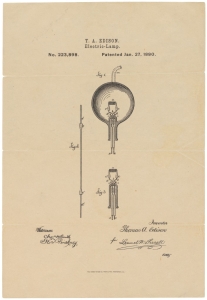
Drawing for an Electric Lamp, 27 January 1880, National Archives at College Park, 595450.
January 27, 1880
Thomas Edison Patents the Light Bulb
On January 27, 1880, Thomas Edison received the patent for his electric lamp. Light bulbs already existed, but Edison's design used a carbon filament (a thin wire), and he found a way to keep air out of the bulb. This meant Edison's light bulbs could last longer before burning out, which helped bring them into the average person's home.
Identify significant inventors of the Industrial Revolution including African Americans and women.
Examples may include, but are not limited to, Lewis Howard Latimer, Jan E. Matzeliger, Sarah E. Goode, Granville T. Woods, Alexander Graham Bell, Thomas Edison, George Pullman, Henry Ford, Orville and Wilbur Wright, Elijah McCoy, Garrett Morgan, Madame C.J. Walker, George Westinghouse.
02/14
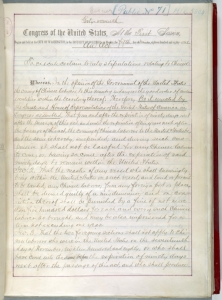
An Act to Execute Certain Treaty Stipulations Relating to Chinese, 6 May 1882, National Archives at Washington, DC, Enrolled Acts and Resolutions of Congress, 5752153.
May 6, 1882
President Arthur Signs the Chinese Exclusion Act
President Chester A. Arthur signed the Chinese Exclusion Act into law on May 6, 1882, banning Chinese laborers from immigrating to the U.S. for ten years. It was the United States' first major law restricting immigration based on race.
Compare the experience of European immigrants in the east to that of Asian immigrants in the west (the Chinese Exclusion Act, Gentlemen's Agreement with Japan).
Examples may include, but are not limited to nativism, integration of immigrants into society when comparing "Old" [before 1890] and "New" immigrants [after 1890], Immigration Act of 1924.
02/14
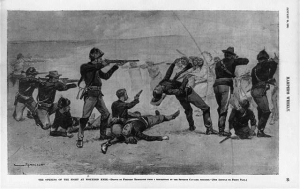
Frederic Remington, The Opening of the Fight at Wounded Knee, 1891, Library of Congress, 97510866.
December 29, 1890
Wounded Knee Massacre
On December 29, 1890, soldiers of the U.S. Army fired on a band of Lakota traveling to the Pine Ridge Agency (also called a reservation). The U.S. Army killed an estimated 90 Lakota men and 200 women and children.
Examples may include, but are not limited to, westward expansion, reservation system, the Dawes Act, Wounded Knee Massacre, Sand Creek Massacre, Battle of Little Bighorn, Indian Schools, government involvement in the killing of the buffalo.
02/14
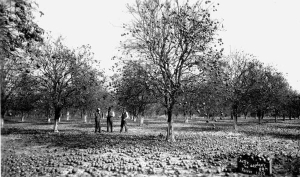
Citrus Grove After Freeze, 29 January 1895, Florida Memory, Reference Collection, RC02364.
1894
The Great Freeze Hurts Florida Citrus Industry
In December 1894 and in February 1895, the Southern United States experienced a drastic drop in temperatures. Florida's citrus industry was hit particularly hard by the sudden cold weather. Citrus growers in the state reported that more than 20,000 acres of planted citrus had been destroyed. It took almost two decades for the industry to recover.
Describe the economic development of Florida's major industries.
Examples of industries may include, but are not limited to, timber, citrus, cattle, tourism, phosphate, cigar, railroads, bridges, air conditioning, sponge, shrimping, and wrecking (pirating).
Analyze the economic challenges to American farmers and farmers' responses to these challenges in the mid to late 1800s.
02/14
Judgment in Plessy v. Ferguson, National Archives at Washington, DC, 1685178.
May 18, 1896
Plessy v. Ferguson
Plessy v. Ferguson (1896) was a landmark Supreme Court case that famously upheld race-based segregation. Although the specific case had focused on a Louisiana law separating train car passengers by race, the decision applied to all areas of social life. The ruling led to the rise of the "separate but equal" doctrine.
Learn More
"Plessy v. Ferguson (1896)," U.S. National Archives and Records Administration, last modified February 8, 2022.
Standards related to major Supreme Court rulings and the experiences of various groups
Analyze significant Supreme Court decisions relating to integration, busing, affirmative action, the rights of the accused, and reproductive rights.
Examples may include, but are not limited to, Plessy v. Ferguson [1896], Brown v. Board of Education [1954], Swann v. Charlotte-Mecklenburg Board of Education [1971], Regents of the University of California v. Bakke [1978], Miranda v. Arizona [1966], Gideon v. Wainwright [1963], Mapp v. Ohio [1961], and Roe v. Wade [1973].
Evaluate the relationship of various ethnic groups to African Americans’ access to rights, privileges and liberties in the United States.
Clarification 1: Instruction includes landmark United States Supreme Court Cases affecting African Americans (e.g., the Slaughter-House cases, Yick Wo v. Hopkins, Plessy v. Ferguson).
Clarification 2: Instruction includes the influence of white and black political leaders who fought on behalf of African Americans in state and national legislatures and courts.
Clarification 3: Instruction includes how organizations, individuals, legislation and literature contributed to the movement for equal rights in the United States (e.g., Sojourner Truth, Frederick Douglass, Carter G. Woodson, Henry Beard Delany, Emma Beard Delaney, Hiram Rhodes Revels).
Clarification 4: Instruction includes how whites who supported Reconstruction policies for freed blacks after the Civil War (white southerners being called scalawags and white northerners being called carpetbaggers) were targeted.
Explain the struggles and successes for access to equal educational opportunities for African Americans.
Clarification 1: Instruction includes how African Americans were impacted by the 1954 Brown v. Board of Education decision that overturned Plessy v. Ferguson.
Clarification 2: Instruction includes Ruby Bridges, James Meredith, Little Rock Nine, 1971 Swann v. Charlotte-Mecklenburg Board of Education and 1978 Regents of the University of California v. Bakke.
Clarification 3: Instruction includes the evolution of Historically Black Colleges and Universities (HBCUs) to include land grant status and liberal arts studies.
Clarification 4: Instruction includes local court cases impacting equal educational opportunities for African Americans.
05/24
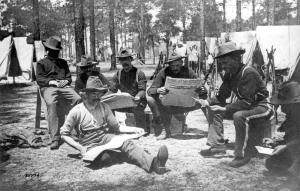
Company E of the 9th Infantry Reading Newspapers During the Spanish-American War, 1898, Florida Memory, Reference Collection, RC06658.
April 21, 1898
The Spanish-American War Begins
The U.S. offered Cuba support in their war for independence from Spain, and so the Spanish-American War began on April 21, 1898, when the U.S. sent ships to blockade Cuban ports. War was formally declared on April 25 and lasted less than four months. The Treaty of Paris of 1898 gave the U.S. control of Puerto Rico, Guam and the Philippines.
Examine causes, course, and consequences of the Spanish American War.
Examples may include, but are not limited to, Cuba as a protectorate, Yellow Journalism, sinking of the Maine, the Philippines, Commodore Dewey, the Rough Riders, acquisition of territories, the Treaty of Paris.
02/14
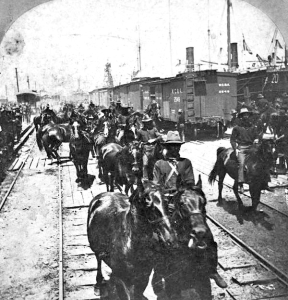
B.L. Singley, Arrival of the Rough Riders - Tampa, Florida, 1898, Florida Memory, N041279.
1898
Roosevelt's Rough Riders Arrive in Tampa
Colonel Theodore Roosevelt and the Rough Riders, more formally known as the 1st United States Volunteer Cavalry, arrived in Tampa in late May 1898. They set up multiple camps in and around Tampa and Lakeland. Wartime spending gave Tampa a major economic boost that fueled its transformation from small town to big city.
Examine causes, course, and consequences of the Spanish American War.
Examples may include, but are not limited to, Cuba as a protectorate, Yellow Journalism, sinking of the Maine, the Philippines, Commodore Dewey, the Rough Riders, acquisition of territories, the Treaty of Paris.
02/14
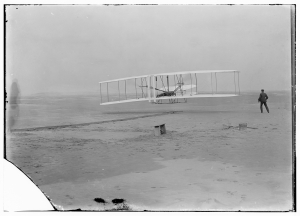
Wilbur Wright, Orville Wright, and John T. Daniels, [First Flight, 120 Feet in 12 Seconds, 10:35 a.m.; Kitty Hawk, North Carolina], [1903 Dec. 17], Library of Congress, Wright Brothers Negatives, 00652085.
December 17, 1903
Wright Brothers' First Flight
On December 17, 1903, Orville and Wilbur Wright conducted the first sustained flight of a powered heavier-than-air aircraft. The Wright brothers spent four years researching and developing the Wright Flyer. The flight lasted 12 seconds and traveled 120 feet.
Identify significant inventors of the Industrial Revolution including African Americans and women.
Examples may include, but are not limited to, Lewis Howard Latimer, Jan E. Matzeliger, Sarah E. Goode, Granville T. Woods, Alexander Graham Bell, Thomas Edison, George Pullman, Henry Ford, Orville and Wilbur Wright, Elijah McCoy, Garrett Morgan, Madame C.J. Walker, George Westinghouse.
02/14
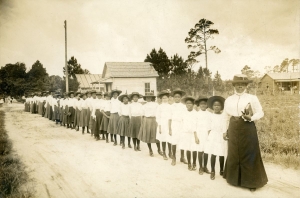
Mary McLeod Bethune with a Line of Girls From the School, circa 1911, Florida Memory, General Collection, MSC5311.
October 3, 1904
Mary McLeod Bethune Opens Her School
Mary McLeod Bethune founded the Daytona Normal and Industrial School for Negro Girls. The school later merged with the Cookman Institute of Jacksonville in 1923 and today is known as Bethune-Cookman University.
Standards related to notable African American leaders in Florida, their contributions, and the impact of African American women in various fields during the 20th century
Identify African American community leaders who made positive contributions in the state of Florida (e.g., Zora Neale Hurston, Florida Highwaymen, Mary McLeod Bethune, Evan B. Forde, Bessie Coleman, Gen. Daniel "Chappie" James, Bob Hayes, Sylvia Fowles).
Examine and analyze the impact and achievements of African American women in the fields of education, journalism, science, industry, the arts, and as writers and orators in the 20th century.
Describe the contributions of significant individuals to Florida.
Examples may include, but are not limited to, John Gorrie, Henry Flagler, Henry Plant, Lue Gim Gong, Vicente Martinez Ybor, Julia Tuttle, Mary McLeod Bethune, Thomas Alva Edison, James Weldon Johnson, Marjorie Kinnan Rawlings.
02/14
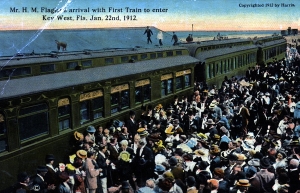
Mr. H.M. Flagler's Arrival with First Train to Enter Key West, Florida, 22 January 1912, Florida Memory, Postcard Collection, PC1732.
January 22, 1912
First Train Arrives in Key West
On January 22, 1912, the first passenger train arrived in Key West, marking the completion of Henry Flagler's East Coast Railroad from Jacksonville to the Southernmost City.
Describe the contributions of significant individuals to Florida.
Examples may include, but are not limited to, John Gorrie, Henry Flagler, Henry Plant, Lue Gim Gong, Vicente Martinez Ybor, Julia Tuttle, Mary McLeod Bethune, Thomas Alva Edison, James Weldon Johnson, Marjorie Kinnan Rawlings.
02/14
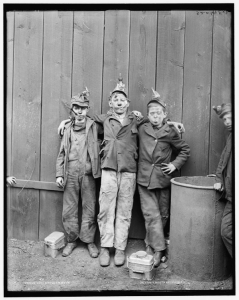
Detroit Publishing Co., Coal Breaker Boys, [between 1890 and 1910], Library of Congress, Detroit Publishing Company Photograph Collection, 2016806752.
September 1, 1916
President Wilson Signs the Keating-Owen Child Labor Act
The Keating-Owen Child Labor Act was a statute that attempted to reduce the use of child labor in the United States. President Woodrow Wilson signed the act into law in 1916, but the act was ruled unconstitutional by the Supreme Court nine months after it went into effect September 1, 1917.
These primary source sets contain documents and photos arranged by topic that teachers can use in their lesson plans. Each set is accompanied by a teacher's guide containing historical context, teaching suggestions, and relevant NGSSS and Florida Standards.

 Listen: The Blues Program