Florida Memory Timeline Challenge banner image with vertical American flag background and smaller images in a line, including a map of Florida, Mary McLeod Bethune, people celebrating V-J Day, Betty Mae Tiger Jumper, and the Challenger space shuttle launch.

Slavery and Emancipation

From the 15th to the 19th century, Europeans captured and transported about 12.5 million Africans to the Americas during what historians call the Atlantic slave trade. The United States Congress outlawed the African slave trade in 1808, but this only made it illegal to import enslaved people. The domestic slave trade, or the slave trade within the boundaries of the United States, continued until slavery was completely banned by the Thirteenth Amendment in 1865.

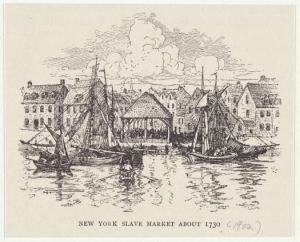
Drawing with ships in the harbor, a market for selling enslaved people, and a crowd of people and buildings along the waterfront.
Harry Fenn, New York Slave Market About 1730, 1902, The New York Public Library Digital Collections, The Miriam and Ira D. Wallach Division of Art, Prints and Photographs: Picture Collection, 807837.
April 6, 1712
Enslaved Africans Rebel in New York City

On the night of April 6, 1712, a group of enslaved Africans in New York City rebelled against slavery. By setting fires as a lure, the group attacked several local white people, killing nine and injuring seven. Out of the 43 enslaved people and one free person put on trial, 25 enslaved people were convicted and sentenced to death.

Learn More

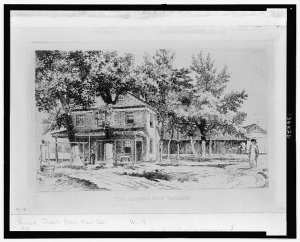
Etching of the Rising Sun Tavern where the Pennsylvania Abolition Society was founded.
Joseph Pennell, The Rising Sun Tavern, [1880], Library of Congress, 2003676225.
April 14, 1775
First Abolitionist Society in the American Colonies

On April 14, 1775, a group of men in Philadelphia established the Society for the Relief of Free Negroes Unlawfully Held in Bondage. It was the first abolitionist society in the American colonies. Most of the men were members of the Society of Friends (or Quakers). They focused on providing legal defense for free Black people, lobbying lawmakers and establishing schools for Black children.

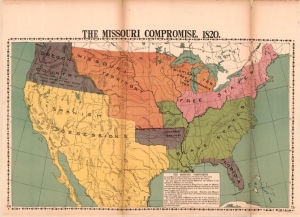
Map of the divisions between free and slave states in the United States after the Missouri Compromise.
Mcconnell Map Co and James McConnell, The Missouri Compromise, 1820, [1919], Library of Congress, 2009581130.
March 6, 1820
President Monroe Signs the Missouri Compromise

The Missouri Compromise admitted Missouri to the Union as a slave state and Maine as a free state. It also outlawed slavery in the rest of the lands from the Louisiana Purchase north of the 36th parallel (an imaginary line 36 degrees north of the equator). This was meant to maintain an equal number of slave and free states in the U.S.

Learn More

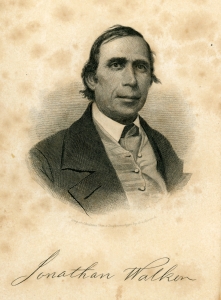
Jonathan Walker.
Joseph Andrews, Jonathan Walker, circa 1850, Florida Memory, General Collection, LIB00012.
November 14, 1844
Abolitionist Jonathan Walker Convicted in Pensacola

On November 14, 1844, abolitionist Jonathan Walker from Massachusetts was convicted in Pensacola, Florida, of stealing slaves after trying to help seven enslaved people sail to freedom in the Bahamas. Part of his sentence included having his right hand branded with the letters "S.S." for "slave stealer." After his release from prison in 1845, he returned North to continue lecturing about the evils of slavery.

Learn More

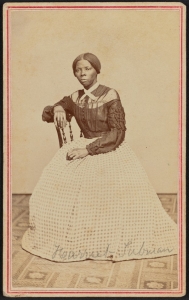
Harriet Tubman.
Benjamin F. Powelson, [Portrait of Harriet Tubman], [1868 or 1869], Library of Congress, Emily Howland Photograph Album, 2018645050.
1850
Harriet Tubman Becomes a Conductor on the Underground Railroad

A year after she followed the Underground Railroad to freedom, Harriet Tubman made her first trip back to Maryland to begin rescuing her family and friends. Over the next ten years, she made 19 trips to the South as a conductor on the Underground Railroad.

Learn More

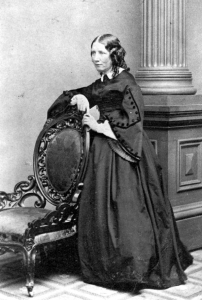
Harriet Beecher Stowe.
Harriet Beecher Stowe, circa 1896, Florida Memory, Print Collection, PR06615.
1852
Harriet Beecher Stowe Publishes Uncle Tom's Cabin

Harriet Beecher Stowe published the anti-slavery novel Uncle Tom's Cabin in 1852. It was wildly popular and had a significant influence on the American public's thoughts on slavery, though some disliked the use of stereotypes about Black people. Stowe also spoke out against slavery in the United States and Europe.

Learn More

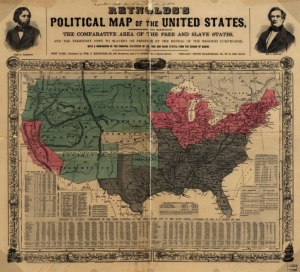
Political map of the United States after the repeal of the Missouri Compromise.
William C. Reynolds and J. C Jones, Reynolds's Political Map of the United States, Designed to Exhibit the Comparative Area of the Free and Slave States and the Territory Open to Slavery or Freedom by the Repeal of the Missouri Compromise, 1856, Library of Congress, 2003627003.
May 30, 1854
President Pierce Signs the Kansas-Nebraska Act

The Kansas-Nebraska Act recognized Kansas and Nebraska as U.S. territories and gave them the power to decide whether to allow slavery. This broke the Missouri Compromise by allowing slavery to spread north of the 36th parallel (an imaginary line 36 degrees north of the equator). The act also led to the creation of the Republican Party and played a key role in beginning the Civil War.

Learn More

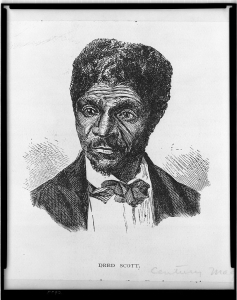
Dred Scott.
Century Company, Dred Scott. Harriet, wife of Dred Scott, [June 1887], Library of Congress, Biographical File Filing Series, 2014645331.
March 6, 1857
Dred Scott v. Sandford

In the Dred Scott decision, the Supreme Court ruled that people of African descent were not U.S. citizens and could not receive any protections the federal government guarantees Americans in the Constitution. The ruling also stated that the Missouri Compromise was unconstitutional, and the federal government could not ban slavery in the territories.

Learn More

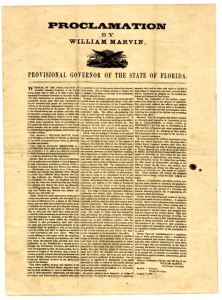
Ten-point proclamation outlining the requirements for Florida to be readmitted to the Union.
Proclamation by William Marvin, Provisional Governor of the State of Florida, 1865, Florida Memory, Collection N2008-10, n2008-10_b001_f01_01.
May 20, 1865
Emancipation Day in Florida

Emancipation in Florida was officially declared on May 20, 1865, in Tallahassee. This was 11 days after the end of the Civil War and two years after President Abraham Lincoln's Emancipation Proclamation declared enslaved people in Southern states were free. May 20 is now celebrated annually as Emancipation Day in Florida.

Learn More

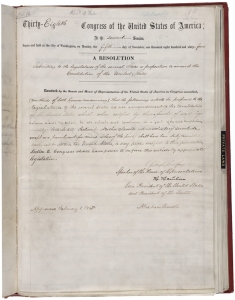
Book page with a mix of the typed and handwritten text for the proposal of the Thirteenth Amendment.
Joint Resolution Proposing the Thirteenth Amendment to the United States Constitution, 31 January 1865, National Archives at Washington, DC, Enrolled Acts and Resolutions of Congress, 1408764.
December 6, 1865
States Ratify the Thirteenth Amendment

When Georgia ratified the Thirteenth Amendment on December 6, 1865, the state provided the final vote necessary for the amendment to become part of the U.S. Constitution. The amendment banned slavery across the United States and in its territories, except as a criminal punishment.

Learn More

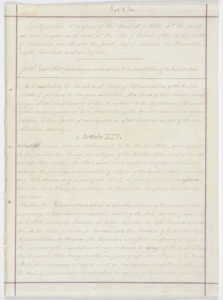
Handwritten book page containing the proposal for the Fourteenth Amendment to the Constitution.
Joint Resolution Proposing the Fourteenth Amendment to the United States Constitution, 13 June 1866, National Archives at Washington, DC, 1408913.
July 9, 1868
States Ratify the Fourteenth Amendment

Ratified on July 9, 1868, the Fourteenth Amendment contains five sections. The most well-known sections are those that grant citizenship to all people born or naturalized in the United States and guarantee all citizens the right to due process and equal protection under the law.

Learn More

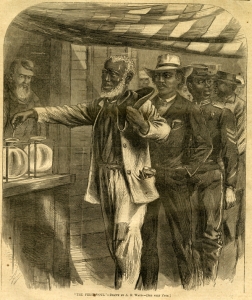
Illustration showing African American men lined up to vote.
Alfred R. Waud, The First Vote of African Americans in Virginia, 1867, Florida Memory, Digital Collection, DLN004262.
February 3, 1870
States Ratify the Fifteenth Amendment

On February 3, 1870, the Fifteenth Amendment was ratified, stating that the right to vote in the United States could not be denied based on race, color or former enslavement. As a result, African American men were guaranteed the right to vote in the U.S. Constitution, but Black Codes, Jim Crow laws and groups like the Ku Klux Klan prevented African American voters from exercising their rights.

Learn More