Florida Memory Timeline Challenge banner image with vertical American flag background and smaller images in a line, including a map of Florida, Mary McLeod Bethune, people celebrating V-J Day, Betty Mae Tiger Jumper, and the Challenger space shuttle launch.

Postwar United States

The United States emerged from World War II as one of the most powerful nations in the world. Many worried the U.S. economy and employment rates would fall after the demand for wartime production ended, but after three years of wartime rationing policies, American consumers were ready to start spending. Some historians call the period after World War II the Golden Age of Capitalism.

Despite the economic boom and the growth of the middle class, the postwar period (1945 to 1968) was marked by its fair share of challenges. The Civil Rights Movement, the Cold War, and the beginning of the Vietnam War, are just some of the events that contributed to the changes in American life after World War II.

First page of the typed Truman Doctrine.
Truman Doctrine, 12 March 1947, Center for Legislative Archives, 2668751.
March 12, 1947
President Announces the Truman Doctrine

On March 12, 1947, President Harry S. Truman asked Congress for $400 million to provide military and economic assistance to Greece and Turkey. This speech marked the beginning of a U.S. foreign policy that pledged support for democratic nations fighting internal or external authoritarian forces.

Learn More

President Truman during dedication day at the Everglades National Park.
President Truman During Dedication Day at the Everglades National Park, 1947 December 6, Florida Memory, Reference Collection, RC08566.
December 6, 1947
Everglades National Park Established

After years of fighting to protect the Florida Everglades from drainage and development, Congress authorized the creation of Everglades National Park in 1934. The Everglades did not officially become a national park until December 6, 1947.

Learn More

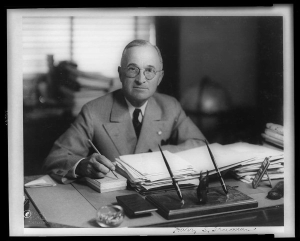
Harry Truman.
[Harry Truman, Half-length Portrait, Seated at Desk, Facing Front, Holding Pencil], c1945 Apr. 19, Library of Congress, 96522971.
March 21, 1947
President Truman's Loyalty Program Begins

On March 21, 1947, President Harry Truman signed Executive Order 9835, which created a loyalty program for federal employees. The goal was to identify and remove any communists in the U.S. government. If a loyalty board decided they had reasonable doubt about an employee's loyalty, they could be fired. Out of more than 3 million federal employees that were investigated, a little over 300 were declared security risks and dismissed from their jobs.

Learn More

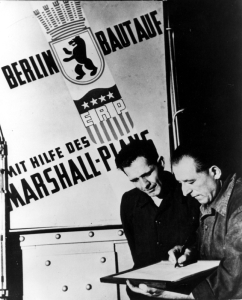
Two workmen looking over a chart with a large sign behind them with German writing.
Marshall Plan in Germany, ca. 1949, Harry S. Truman Library, 338944846.
April 3, 1948
President Truman Signs the Marshall Plan

In 1947, Secretary of State George Marshall proposed that the U.S. provide economic assistance to Europe to help them recover from World War II. President Harry Truman signed the European Recovery Program, or the Marshall Plan, into law on April 3, 1948. By supporting Western Europe's economy, the U.S. aimed to keep the country from falling into another depression through trade with other nations and stop the Soviet Union's control of Eastern Europe from spreading.

Learn More

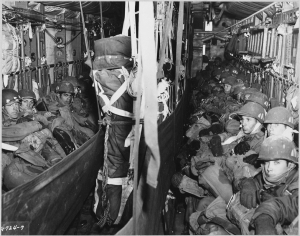
Paratroopers of the 187th Airborne Regimental Combat Team seated in the cargo compartment of a military transport aircraft.
Combat Cargo, Korea -- Paratroopers of the 187th Airborne Regimental Combat Team, Seated in the Cargo Compartment of 314th Troop Carrier Group C-119 "Flying Boxcar," "Sweat Out" the Flight to the Dropzone at Munsan-ni, Korea, in March, 1951, March 1951, National Archives at College Park, 542315.
June 27, 1950
President Truman Commits U.S. Forces to the Korean War

At the end of World War II, Japan was forced to end their 30-year occupation of Korea, which was then divided along the 38th parallel into North and South Korea. With the support of the Soviet Union, North Korea invaded South Korea on June 25, 1950. The United Nations quickly responded, and the United States led the UN's efforts to support South Korea. President Truman described the decision to support South Korea as part of the country's commitment to stopping the spread of communism.

Learn More

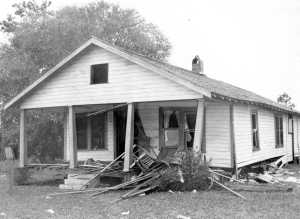
Destroyed home of Harry and Hariette Moore.
Bombing of Home of Harry and Harriette Moore - Mims, Florida, 25 December 1951, Florida Memory, Print Collections, PR05144.
December 25, 1951
Assassination of Harry T. and Harriette Moore

Harry T. and Harriette Moore were civil rights activists who helped form the Brevard County chapter of the NAACP in 1934. Their work made them targets of the Ku Klux Klan, and Klan members planted a bomb underneath the Moore home. On December 25, 1951, the bomb exploded. Harry died the same day while Harriette died nine days later.

Learn More

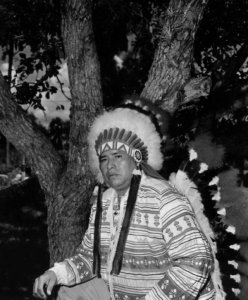
Billy Osceola.
First Elected Chairman of the Seminole Tribe of Florida, Billy Osceola, 1965, Florida Memory, Department of Commerce Collection, C650736.
1957
Seminole Tribe of Florida Recognized by U.S. Government

The Seminole Tribe of Florida received federal recognition in 1957. Federally recognized tribes are legally recognized by the United States Bureau of Indian Affairs as independent nations with the right to govern themselves.

Learn More

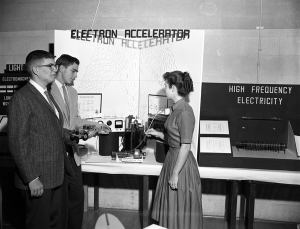
Three high school seniors gathered around a display with the title Electron Accelerator at the Big Bend Science Fair in Tallahassee, Florida.
High School Seniors Gathered Around Exhibit at the Big Bend Science Fair in Tallahassee, 4 March 1960, Florida Memory, Tallahassee Democrat Collection, TD00785F.
September 2, 1958
National Defense Education Act Boosts Space Industry

The National Defense Education Act of 1958 was signed into law on September 2 by President Dwight D. Eisenhower. The act provided federal funding to schools at all levels and loans to people who wanted to become teachers. Money poured into the state to help educate Floridians to work in the space industry.

Learn More

The XLR115 liquid-hydrogen-fueled rocket engine against a red background.
Rocket Engine Developed by Pratt and Whitney Aircraft, July 1959, Florida Memory, Reference Collection, RC08589.
1959
Pratt & Whitney Aircraft Develop Rocket Engine

The Pratt & Whitney Aircraft XLR115 liquid-hydrogen-fueled rocket engine, developed at the Florida Research and Development Center, was designed to be used in the Centaur and Saturn space vehicles.

Learn More

Soviet cosmonaut Yuri Gagarin at a press conference during his visit to Finland.
Arto Jousi, Yuri Gagarin, 3 July 1961, Wikimedia Commons, Finnish Museum of Photography, Public Domain, [N/A].
April 12, 1961
First Human Spaceflight

Yuri Gagarin became the first person to travel into outer space on April 12, 1961. He completed the first single orbit of the planet aboard the Vostok 1 spacecraft. Gagarin became an international hero and traveled the world to promote the Soviet space program. After Gagarin's success, President Kennedy announced the U.S. would put a man on the moon by the end of the 1960s.

Learn More

Four planes flying above an aircraft carrier during the Bay of Pigs Invasion.
Robert L. Lawson, A4D-2 Skyhawks of VA-34 in Flight Over USS Essex (CVS-9) During the Bay of Pigs Invasion in April 1961, April 1961, Wikimedia Commons, Public Domain, [N/A].
April 17, 1961
Bay of Pigs Invasion

Soon after Fidel Castro took control of Cuba, the U.S. began planning to overthrow him. In 1960, under President Eisenhower, the Central Intelligence Agency started training Cuban exiles for an invasion, and President Kennedy launched the attack. The main invasion force landed at the Bay of Pigs on April 17, 1961, but they were quickly defeated by Castro's forces.

Learn More

  • "The Bay of Pigs," The John F. Kennedy Presidential Library and Museum, last modified November 7, 2024.

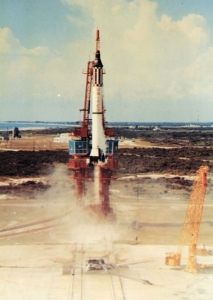
The Mercury-Redstone 3 also known as Freedom 7 launching from Cape Canaveral, Florida.
Launch of the Mercury-Redstone 3 from Cape Canaveral, 5 May 1961, Florida Memory, Postcard Collection, PC12749.
May 5, 1961
America's First Man in Space

On May 5, 1961, Alan B. Shepard, a U.S. Navy test pilot, became the first American in space and the second person in space just three weeks after the Soviet cosmonaut Yuri Gagarin. He piloted the Freedom 7, a Mercury spacecraft, on a suborbital flight that lasted 15 minutes and 28 seconds.

Learn More

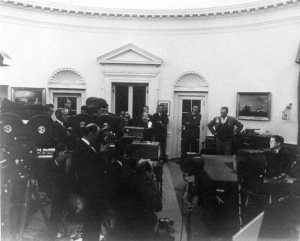
President John F. Kennedy in the Oval Office announcing the U.S. naval blockade of Cuba in front of a gathering of cameras and reporters.
President John F. Kennedy Delivering His Ultimatum to the Russians and Announcing the U.S. Naval Blockade of Cuba, 22 October 1962, Florida Memory, Reference Collection, RC13826.
1962
The Cuban Missile Crisis

On October 16, 1962, President John F. Kennedy and his advisors learned the Soviet Union was installing nuclear missiles in Cuba, just 90 miles away from Florida. The next thirteen days became known as the Cuban Missile Crisis, and the peaceful resolution of the crisis would later be considered one of President Kennedy's greatest achievements.

Learn More

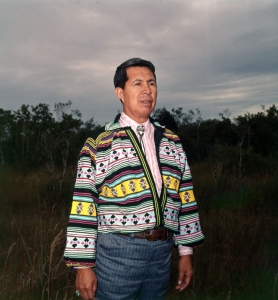
Miccosukee Chief Buffalo Tiger standing in a field.
Miccosukee Chief Buffalo Tiger, 1973, State Library of Florida, Florida Photographic Collection, DC723175.
1962
Miccosukee Tribe of Indians of Florida Recognized by U.S. Government

Cultural differences between the Miccosukee Tribe of Indians of Florida and the Seminole Tribe of Florida led to their formal separation in the 1950s. The state recognized the Miccosukee as a separate tribe in 1957, the same year the Seminole received federal recognition, and the Miccosukee Tribe received federal recognition in 1962.

Learn More

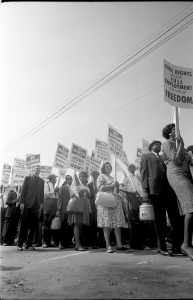
Demonstrators marching in the street holding signs with messages supporting equal employment and civil rights during the March on Washington.
Marion S. Trikosko, [Demonstrators Marching in the Street Holding Signs During the March on Washington, 1963], 28 August 1963, Library of Congress, 2013647403.
August 28, 1963
March on Washington

The March on Washington for Jobs and Freedom took place on August 28, 1963. More than 200,000 people marched to demand an end to racial segregation, employment discrimination, and other civil rights abuses. Leaders from the major civil rights organizations attended.

Learn More

Edsel Dozier reading about President Kennedy's assassination in the newspaper.
Edsel Dozier Reading About President Kennedy Assassination in the Tallahassee Democrat Newspaper, 23 November 1963, Florida Memory, Tallahassee Democrat Collection, TD01587.
November 22, 1963
Assassination of President John F. Kennedy

On November 22, 1963, President John F. Kennedy was assassinated while riding in a motorcade along a ten-mile route through downtown Dallas. Texas Governor John B. Connally, who was in the car with the president, was also shot but survived. Support for the Civil Rights Act grew after Kennedy's assination, and President Lyndon B. Johnson encouraged Congress to pass the act in Kennedy's honor.

Learn More

Clarence Earl Gideon.
Portrait of Clarence Earl Gideon, circa 1964, Florida Memory, Reference Collection, RC12789.
1963
Gideon v. Wainwright

In the landmark case of Gideon v. Wainwright (1963), the U.S. Supreme Court confirmed that people have the right to an attorney, even when they are not on trial for a capital offense. Capital offenses are crimes where the maximum punishment is the death penalty.

Learn More

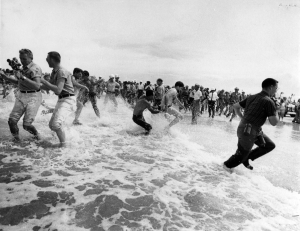
Still image taken from a Highway Patrol film depicting pro-segregationists attempting to prevent Black people from swimming at a white-only beach in St. Augustine.
Segregationists Trying to Prevent Blacks From Swimming at a "White Only" Beach in St. Augustine, 25 June 1964, Florida Memory, Reference Collection, RC12407.
1964
Saint Augustine Civil Rights Protests

During the summer of 1964, Saint Augustine, Florida, became a major battleground in the Civil Rights Movement. The U.S. Congress was debating civil rights legislation at that time, and the protests in Saint Augustine helped convince many lawmakers to vote in favor of the Civil Rights Act of 1964, which President Lyndon B. Johnson signed into law on July 2, 1964.

Learn More

President Lyndon B. Johnson handing a pen to Dr. Martin Luther King, Jr. at the signing of the Civil Rights Act.
Cecil Stoughton, Signing of the Civil Rights Act of 1964, 2 July 1964, Lyndon Baines Johnson Library, 276-13-WH64.
July 2, 1964
President Lyndon B. Johnson Signs the Civil Rights Act into Law

President Lyndon B. Johnson signed the Civil Rights Act of 1964 into law on July 2, 1964. The act includes seven titles (or parts) that cover a range of topics. Some of the well-known titles make discrimination illegal in public spaces, in federally funded programs, and for businesses. The Civil Rights Act was an important achievement for the Civil Rights Movement as well as other social movements in the United States.

Learn More

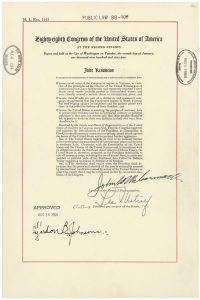
Page of typed text containing the Tonkin Gulf Resolution signed by President Lyndon B. Johnson.
Joint Resolution for the Maintenance of Peace and Security in Southeast Asia, 10 August 1964, Lyndon Baines Johnson Library, 2803448.
August 7, 1964
88th United States Congress Passes the Tonkin Gulf Resolution

On August 4, 1964, President Lyndon B. Johnson announced North Vietnam had attacked two U.S. Navy ships in international waters. President Johnson ordered air strikes in response and asked Congress to pass a resolution to support these actions. Congress passed the Tonkin Gulf Resolution on August 7, 1964, granting President Johnson the power to take military action in Vietnam without a formal declaration of war being passed by Congress.

Learn More

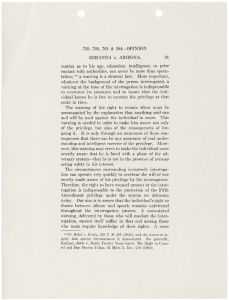
Page of typed text containing the opinion of the Court by Chief Justice Earl Warren in the case of Miranda v. Arizona.
Supreme Court of the United States, Opinion of the Court by Chief Justice Earl Warren in the Case of Miranda v. Arizona, 13 June 1966, National Archives at Washington, DC, 597564.
June 13, 1966
Miranda v. Arizona

Miranda v. Arizona (1966) was a landmark Supreme Court case that ruled police must tell people their Fifth Amendment rights at the time of their arrest, namely the right to remain silent and the right to an attorney when being questioned by the police.

Learn More

Betty Mae Tiger Jumper.
Marks, Seminole Indian Betty Mae Jumper, 1967, Florida Memory, Department of Commerce Collection, C671293.
June 5, 1967
First Woman to Chair the Seminole Tribal Council

Betty Mae Tiger Jumper became the first chairwoman of the Seminole Tribe of Florida on June 5, 1967. She worked to improve the tribe's finances and provide better education and healthcare to Seminole youth. She co-founded the United Southeastern Tribes in 1968, and President Richard Nixon appointed her to the National Council on Indian Opportunity in 1970.

Learn More

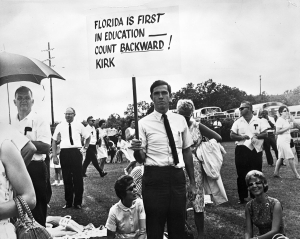
Florida teachers during their 1968 walkout with one male teacher holding up a sign that reads Florida is First in Education Count Backward Kirk.
Florida Teachers Displaying Protest Signs During Their Walkout, 1968, Florida Memory, Political Collection, PT00680.
February 19, 1968
First Statewide Teachers' Strike

In February 1968, the state teachers' union, the Florida Education Association (FEA), staged the first statewide teachers strike in the country. The strike occurred in response to Governor Claude Kirk's refusal to meet FEA demands on salary and school budget increases.

Learn More

Still image taken from a Highway Patrol film showing Dr. Martin Luther King Jr. speaking at a podium with Ralph Abernathy standing beside him.
Ralph Abernathy and Martin Luther King, Jr. - Saint Augustine, Florida, 1964, Florida Memory, Reference Collection, RC12406.
April 4, 1968
Assassination of Dr. Martin Luther King Jr.

Civil rights leader Dr. Martin Luther King, Jr. was assassinated on April 4, 1968. The reaction across the United States was a mixture of disbelief, grief, and at times violent anger. Reactions to Dr. King's death were just as passionate in Florida.

Learn More

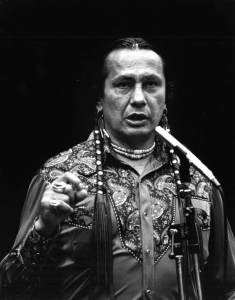
Russell Means speaking at the Miami-Dade Community College south campus.
Actor and Political Activist Lakota Indian Russell Means Speaking at the Miami-Dade Community College South Campus - Kendall, Florida, 14 April 1983, Florida Memory, PR22089.
1968
The American Indian Movement (AIM) Founded

The American Indian Movement (AIM) was founded in Minneapolis, Minnesota, during the summer of 1968 by a group of Native activists, including Clyde and Vernon Bellecourt, Dennis Banks, Eddie Benton-Banai, and George Mitchell. From the late 1960s through the 1980s, AIM was the most well-known Native American civil and political rights organization. AIM's takeover of the Bureau of Indian Affairs building in Washington, D.C. in 1972 and their standoff with the FBI at Wounded Knee in 1973 drew worldwide attention.

Learn More