Florida Memory is administered by the Florida Department of State, Division of Library and Information Services, Bureau of Archives and Records Management. The digitized records on Florida Memory come from the collections of the State Archives of Florida and the special collections of the State Library of Florida.
The pre-Columbian era includes almost 13,000 years of human history before 1492, the year Christopher Columbus arrived in what we now call the Americas. Most of this time falls into two periods called "prehistory" and "ancient history," which we can learn about through archaeology.
Archaeology uses objects called artifacts to study how people lived. It is an important tool for learning about human ways of life before writing became a popular method for recording history. It can be hard, or even impossible, to get an exact date for something using archaeology, but archaeologists have ways of making very accurate estimates.
During the pre-Columbian era, millions of Native peoples lived in the Americas. Today, the United States government formally recognizes 574 tribes, but this is only a fraction of the pre-Columbian Native civilizations. When the Europeans arrived, they brought war and deadly diseases, including smallpox, measles and malaria, that led to the deaths of an estimated 90% of the Native population in less than 200 years.
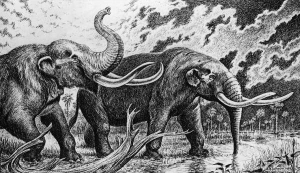
Andrew R. Janson, Pleistocene Mastodons, 1956, Florida Memory, Print Collection, PR00204.
12500 B.C.E.
First Peoples Move Into Florida
Referred to today as Paleoindians, the Florida Ancestors moved into the peninsula about 14,500 years ago (or 12500 B.C.E.) in search of new food sources, including mastodons, giant armadillos and horses. At that time, the end of the last Ice Age, Florida was twice the size it is today.
Identify Native American tribes from different geographic regions of North America (cliff dwellers and Pueblo people of the desert Southwest, coastal tribes of the Pacific Northwest, nomadic nations of the Great Plains, woodland tribes east of the Mississippi River).
Examples may include, but are not limited to, those listed in the benchmark.
02/14
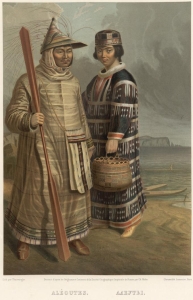
Kārlis Hūns, Aleuty, 1862, Library of Congress, Ethnographic Description of the Peoples of Russia, World Digital Library, 2018689044.
7000 B.C.E.
Unangax̂ Settle the Aleutian Islands
The Unangax̂, also called Aleuts, settled what are now known as the Aleutian Islands in Alaska. Based on artifacts, this settlement happened around 9,000 years ago (or 7000 B.C.E.). The extreme weather led the Unangax̂ to make clothing from sea lions, walruses, harbor seals, or even whales because their skins were naturally waterproof and good at trapping in heat.
Learn More
"Unangan Culture," The Qawalangin Tribe of Unalaska, accessed August 5, 2025.
Identify Native American tribes from different geographic regions of North America (cliff dwellers and Pueblo people of the desert Southwest, coastal tribes of the Pacific Northwest, nomadic nations of the Great Plains, woodland tribes east of the Mississippi River).
Examples may include, but are not limited to, those listed in the benchmark.
Compare cultural aspects of Native American tribes from different geographic regions of North America including but not limited to clothing, shelter, food, major beliefs and practices, music, art, and interactions with the environment.
02/14
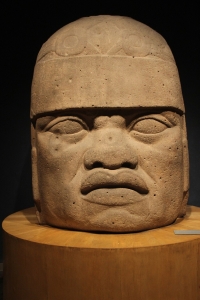
Gary Todd, Olmec Colossal Head, San Lorenzo, Veracruz, 4 July 2012, Wikimedia Commons, Public Domain, [N/A].
1200 B.C.E.
Olmec Civilization Emerges
Around 1200 B.C.E., the Olmec civilization emerged in what is now southeastern Mexico. The name Olmec comes from Nahuatl, the Aztec language, and can be translated to "rubber people." They made and traded rubber as well as pottery, feathers, gems and rocks. They are also remembered for making giant stone heads, complex jade carvings, and figurines that blended humans with jaguars, serpents, alligators and other animals.
Learn More
Mark Cartwright, "Olmec Civilization," in World History Encyclopedia (2018).
"Olmec Civilization," National Geographic Society, last modified February 27, 2024.
Standards related to comparing the cultural aspects of ancient Native civilizations
Compare cultural aspects of Native American tribes from different geographic regions of North America including but not limited to clothing, shelter, food, major beliefs and practices, music, art, and interactions with the environment.
02/14
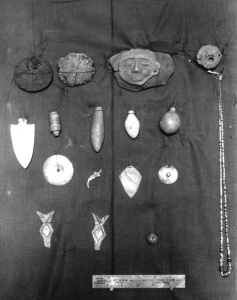
Artifacts From the Hillsborough County Archaeology Project, Thomas Mound Site IXA, 13 December 1937, Florida Memory, Florida Geological Survey Collection, GE1437.
100
Calusa Control Southwest Florida
From about 100 C.E. to the mid-18th century, the Calusa people controlled much of what is now southwest Florida. They were experts in fishing and used shells to make tools and jewelry and built large mounds with the leftovers. One of these mounds called Mound Key is believed to have been the center of the Calusa kingdom.
Compare cultural aspects of Native American tribes from different geographic regions of North America including but not limited to clothing, shelter, food, major beliefs and practices, music, art, and interactions with the environment.
02/14
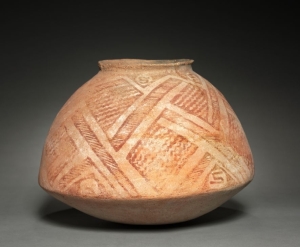
Large Storage Jar, c. 900–1100, Cleveland Museum of Art, James Albert and Mary Gardiner Ford Memorial Fund, 1983.16.
450
Hohokam Culture Emerges
The name Hohokam is used by archaeologists to describe several groups of people who shared similar ways of life between 450 C.E. and 1450. Despite living in the deserts of what is now the southwestern United States and northwest Mexico, these groups were skilled farmers who built complex canal systems to grow crops. They also made pottery, played ball games and carved images called petroglyphs into rocks.
Compare cultural aspects of Native American tribes from different geographic regions of North America including but not limited to clothing, shelter, food, major beliefs and practices, music, art, and interactions with the environment.
02/14
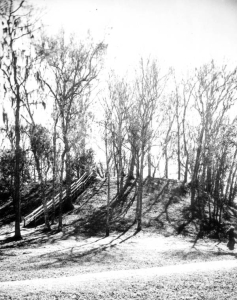
View of Temple Mound and Stairs at Lake Jackson Mounds State Park: Tallahassee, Florida, circa 1980, Florida Memory, Print Collection, PR10603.
900
Mississippian Culture Emerges
The name "Mississippian Culture" is used to describe the Native peoples that lived in what is now the Midwest and Southeast United States from around 900 C.E. until the 1700s. Although all Mississippian groups were unique, the Mississippian people were generally known for building large mounds and farming the "Three Sisters" (corn, beans and squash).
Learn More
Adam King, "Mississippian Period," in New Georgia Encyclopedia (Georgia Humanities, University of Georgia Press, 2021), accessed August 6, 2025.
Compare cultural aspects of Native American tribes from different geographic regions of North America including but not limited to clothing, shelter, food, major beliefs and practices, music, art, and interactions with the environment.
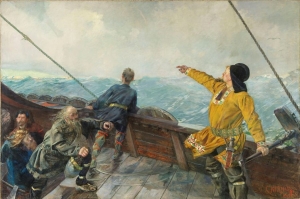
Around 1000 C.E., Leif Erikson and his crew landed in an area covered in rocks and glaciers he called Helluland. Historians think Helluland included modern day Baffin Island and the Torngat Mountains, an Inuit homeland. This would make Erikson and his crew the first Europeans to explore the continent now known as North America.
Learn More
Birgitta Wallace, "Leif Eriksson," in The Canadian Encyclopedia (Historica Canada, 2006), accessed December 5, 2025.
Standards related to European motives for exploring and colonizing the Americas
Investigate (nationality, sponsoring country, motives, dates and routes of travel, accomplishments) the European explorers.
In addition to those listed in the benchmark, examples may include, but are not limited to, Spanish, English, Dutch, Icelandic (Viking), and Swedish explorers.
02/14
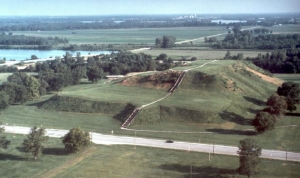
Historic Route 66 - An Aerial View of Monks Mound, National Archives at College Park, 7719452.
1100
Cahokia Flourishes as a Cultural Center
Although people had lived in the Cahokia region for thousands of years, around 700 B.C.E. and 1000 C.E., larger groups began settling there. By 1100 C.E., Cahokia entered its Golden Age with a population of 15,000 to 20,000 people. The city was made up of more than 100 large mounds. Most of the people were farmers and grew maize (or corn), squash, grains and sunflowers.
Identify Native American tribes from different geographic regions of North America (cliff dwellers and Pueblo people of the desert Southwest, coastal tribes of the Pacific Northwest, nomadic nations of the Great Plains, woodland tribes east of the Mississippi River).
Examples may include, but are not limited to, those listed in the benchmark.
Compare cultural aspects of Native American tribes from different geographic regions of North America including but not limited to clothing, shelter, food, major beliefs and practices, music, art, and interactions with the environment.
02/14
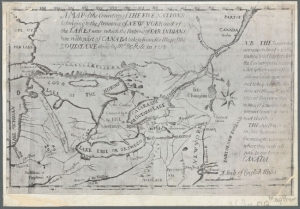
Guillaume de L'Isle, A Map of the Countrey of the Five Nations Belonging to the Province of New York and of the Lakes Near Which the Nations of Far Indians Live With Part of Canada: Taken From the Map of the Louisiane Done by Mr. Delisle in 1718, The New York Public Library Digital Collections, Lionel Pincus and Princess Firyal Map Division, 56815687.
1142
Haudenosaunee Confederacy Forms
The exact year is unknown, but some scholars estimate that the Haudenosaunee Confederacy formed around 1142. The Confederacy's territory included modern-day New York, southeast Canada, and northern Pennsylvania. The Confederacy was made up of five nations: Mohawk, Oneida, Cayuga, Seneca, and Onondaga. Later, the Tuscarora joined after fleeing a war with British settlers in the Carolinas.
Learn More
"The Haudenosaunee," in Indigenous Appalachia (WVU Art in the Libraries and the WVU Native American Studies Program, 2022).
Standards related to comparing the cultural aspects of Native tribes and ancient civilizations
Identify Native American tribes from different geographic regions of North America (cliff dwellers and Pueblo people of the desert Southwest, coastal tribes of the Pacific Northwest, nomadic nations of the Great Plains, woodland tribes east of the Mississippi River).
Examples may include, but are not limited to, those listed in the benchmark.
02/14
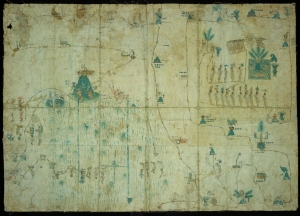
The Sigüenza Map, [1500 to 1599], Library of Congress, World Digital Library, 2021668420.
1325
The Aztec Establish Tenochtitlán
Tenochtitlán was the capital of the Triple Alliance (or the Aztec Empire). The city was built around 1325, but the Triple Alliance did not form until about 1428. Some things the Aztec are remembered for today include building flat-top pyramids, studying the planets and stars to create a 365-day calendar, believing in many gods, and being very successful farmers.
Learn More
"Aztec Civilization," National Geographic Society, last modified October 19, 2023.
"Tenochtitlan," National Geographic Society, last modified October 19, 2023.
Standards related to comparing the cultural aspects of ancient Native civilizations
These primary source sets contain documents and photos arranged by topic that teachers can use in their lesson plans. Each set is accompanied by a teacher's guide containing historical context, teaching suggestions, and relevant NGSSS and Florida Standards.

 Listen: The Blues Program