Florida Memory Timeline Challenge banner image with vertical American flag background and smaller images in a line, including a map of Florida, Mary McLeod Bethune, people celebrating V-J Day, Betty Mae Tiger Jumper, and the Challenger space shuttle launch.

Contemporary United States

The contemporary United States has been shaped by major social, political and technological changes. The period overlaps with the Cold War and the Civil Rights Movement, but it is a much broader way of grouping historical events that occurred between 1968 and the present. From the Space Race to the Global War on Terrorism, the events of this period are the most likely moments of American history to be remembered by people who are alive today.

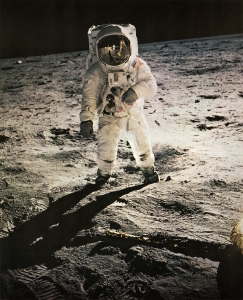
Astronaut Buzz Aldrin in his spacesuit on the surface of the moon.
Astronaut Aldrin's Faceplate Reflecting Neil Armstrong on the Moon, 1969, Florida Memory, Print Collection, PR10187.
July 20, 1969
First Humans on the Moon

On July 20, 1969, Commander Neil Armstrong and Lunar Module Pilot Edwin "Buzz" Aldrin, Jr. landed in the Sea of Tranquility and became the first humans to walk on the moon.

Learn More

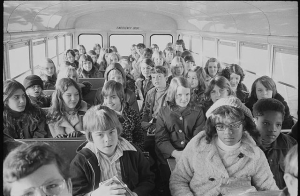
African American and white school children on a school bus.
Warren K. Leffler, [African American and White School Children on a School Bus, Riding From the Suburbs to an Inner City School, Charlotte, North Carolina], 21 February 1973, Library of Congress, 2011648709.
April 20, 1971
Swann v. Charlotte-Mecklenburg Board of Education

Brown v. Board of Education declared racial segregation in public schools unconstitutional, but state governments were slow to desegregate. After African American parents sued the Charlotte-Mecklenburg school board, a federal court ordered the board to use buses to integrate in 1969. On April 20, 1971, the Supreme Court upheld the ruling and declared bussing a constitutional tool for integrating public schools.

Learn More

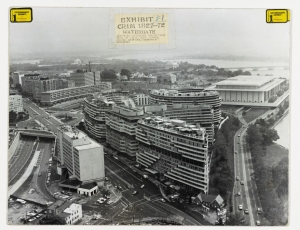
Panoramic view of the Watergate Hotel.
[U.S. v. Liddy] Government Exhibit 1: Panoramic View, Elevations, and Floor Plans of Watergate and Howard Johnson's Motor Lodge, National Archives at College Park, 304965.
June 17, 1972
Break-in at the Watergate Hotel

On June 17, 1972, five people broke into the Democratic National Committee offices at the Watergate Complex to take pictures, plant listening devices, and steal documents. They were caught on the scene and arrested. The break-in was part of a plan to reelect President Richard Nixon. The Watergate scandal damaged public trust in the government and led to new laws on campaign contributions and spending.

Learn More

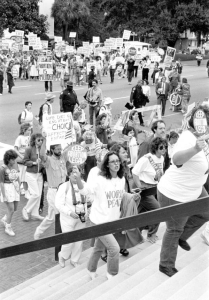
Pro-choice and pro-life activists demonstrating in Tallahassee, Florida.
Abortion Activists Demonstrating - Tallahassee, Florida, 10 October 1989, Florida Memory, Print Collections, PR02876.
January 22, 1973
Roe v. Wade

On January 22, 1973, the U.S. Supreme Court ruled abortions were protected by the Constitution under the right to privacy guaranteed to U.S. citizens by the Due Process Clause of the Fourteenth Amendment. The Roe ruling also stated these rights were limited in the late stages of pregnancy. Roe v. Wade was overturned in 2022.

Learn More

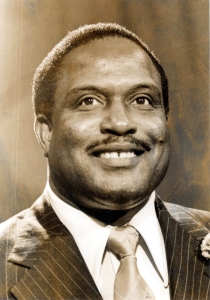
Judge Joseph Hatchett.
Portrait of Judge Joseph Hatchett, 1979, Florida Memory, Mark Foley Collection, N2006-6, MF0149.
1975
First African American Appointed to Florida's Supreme Court

In 1975, Governor Reubin Askew appointed Joseph Woodrow Hatchett to the Florida Supreme Court. A year later, he defended his seat on the court and became the first African American in the 20th century to win a contested election in Florida.

Learn More

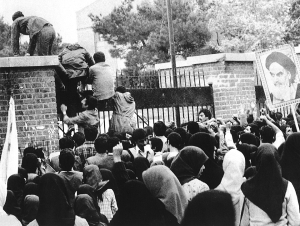
Students climbing over the gate outside the U.S. Embassy in Tehran.
Iran Hostage Crisis - Iranian Students Climb Up U.S. Embassy Gates in Tehran, 4 November 1979, Wikimedia Commons, Shiraz University, Public Domain, [N/A].
November 4, 1979
Iran Hostage Crisis Begins

The Iran Hostage Crisis began on November 4, 1979, when a group of protestors who supported the Iranian Revolution stormed the U.S. Embassy in Tehran and took 66 American hostages. Some of the hostages were released, but 52 people were held for 444 days. The U.S. government's failure to solve the crisis quickly and a failed military rescue damaged the country's reputation as a superpower.

Learn More

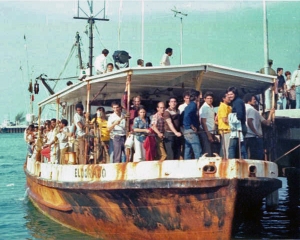
A rusty boat named the El Dorado arriving in Key West with dozens of Cuban migrants standing on the deck.
Dale M. McDonald, The "El Dorado" Arriving with Cuban Refugees During the Mariel Boatlift - Key West, Florida, 1980, Florida Memory, Dale M. McDonald Collection, DM1352.
1980
The Mariel Boatlift

Between April and October of 1980, approximately 125,000 Cubans journeyed from Cuba's Mariel Harbor to South Florida. At the same time, 25,000 Haitian refugees fled to the U.S. Many Americans disapproved of the boatlift and the U.S. government's open arms immigration policy.

Learn More

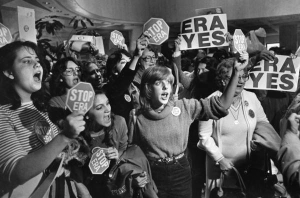
Women holding signs in support of or against the Equal Rights Amendment.
Donn Dughi, ERA Pro and Con Demonstrators Try to Outshout Each Other in the Legislative Halls - Tallahassee, Florida, 18 January 1982, Florida Memory, Donn Dughi Collection, DND0218.
1982
Final Vote on the Equal Rights Amendment

In 1972, the Equal Rights Amendment (ERA), which would guarantee equal protection for women under the law, passed in the U.S. Congress and was sent to the states for ratification. The ERA was introduced or voted on in all of Florida's legislative sessions from 1972 until 1982 where it failed in the Senate during a final vote in 1982.

Learn More

Space shuttle Challenger lifting off from Pad 30B.
Space Shuttle Challenger Liftoff, 28 January 1986, Florida Memory, Print Collection, PR10268.
January 28, 1986
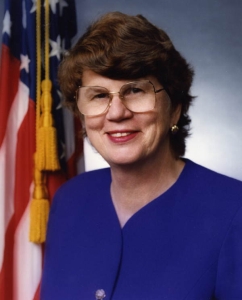
Janet Reno.
Janet Reno, 25 March 1993, Florida Memory, Political Collection, PT02144.
May 12, 1993
First Female U.S. Attorney General

Janet Reno became the first woman to serve as U.S. Attorney General in 1993. Bill Clinton, the incoming president, appointed her on February 11, and she was sworn in on May 12. Reno was also the first woman to serve as a state attorney in Florida.

Learn More

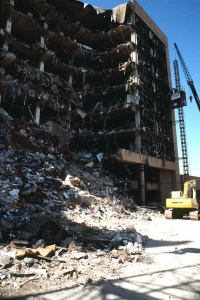
Construction workers erect an external elevator on the side of the Federal Building following the Oklahoma City Bombing.
Mark A. Moore, Oklahoma City Bombing. Construction Workers Erect an External Elevator on the Side of the Federal Building, 21 April 1995, National Archives at College Park, 6492656.
April 19, 1995
Oklahoma City Bombing

On April 19, 1995, two U.S. veterans planted a homemade bomb in a truck outside the Alfred P. Murrah Federal Building in Oklahoma City. The explosion killed 168 people, and more than 850 people were injured. The attack led to changes in security at federal buildings in major cities.

Learn More

  • Stephen Sloan, "Oklahoma City Bombing," in The Encyclopedia of the Great Plains, ed. David J. Wishart (University of Nebraska–Lincoln, 2011).

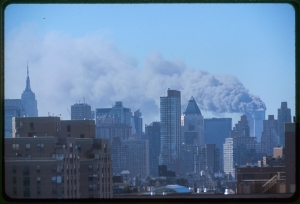
Manhattan skyline with smoke coming from the Twin Towers after the September 11th attack on the World Trade Center.
[Skyline of Manhattan with Smoke Billowing From the Twin Towers Following September 11th Terrorist Attack on World Trade Center, New York City], 11 September 2001, Library of Congress, Unattributed 9/11 Photographs, 2002719353.
September 11, 2001
September 11 Attacks

On September 11, 2001, terrorists linked to the militant organization al-Qaeda attacked the World Trade Center in New York City and the Pentagon in Arlington, Virginia. The World Trade Center and the Pentagon were struck by hijacked airplanes. A fourth plane crashed into a field near Shanksville, Pennsylvania, after the passengers fought back. Nearly 3,000 people died in the attacks.

Learn More

  • "Remembering 9/11," U.S. National Archives and Records Administration, last modified September 10, 2024.