Florida Memory Timeline Challenge banner image with vertical American flag background and smaller images in a line, including a map of Florida, Mary McLeod Bethune, people celebrating V-J Day, Betty Mae Tiger Jumper, and the Challenger space shuttle launch.

Cold War

After World War II, the United States and the Soviet Union began a decades-long struggle for power. While the two countries avoided sending their soldiers to face one another on the battlefield directly, there was no shortage of conflict. From spying and propaganda to the arms race and proxy wars between different countries, the allies of the two countries were also drawn into the tension, turning the rivalry between the United States and Soviet Union into a global one.

First page of the typed Truman Doctrine.
Truman Doctrine, 12 March 1947, Center for Legislative Archives, 2668751.
March 12, 1947
President Announces the Truman Doctrine

On March 12, 1947, President Harry S. Truman asked Congress for $400 million to provide military and economic assistance to Greece and Turkey. This speech marked the beginning of a U.S. foreign policy that pledged support for democratic nations fighting internal or external authoritarian forces.

Learn More

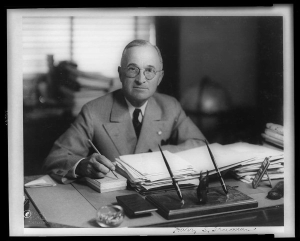
Harry Truman.
[Harry Truman, Half-length Portrait, Seated at Desk, Facing Front, Holding Pencil], c1945 Apr. 19, Library of Congress, 96522971.
March 21, 1947
President Truman's Loyalty Program Begins

On March 21, 1947, President Harry Truman signed Executive Order 9835, which created a loyalty program for federal employees. The goal was to identify and remove any communists in the U.S. government. If a loyalty board decided they had reasonable doubt about an employee's loyalty, they could be fired. Out of more than 3 million federal employees that were investigated, a little over 300 were declared security risks and dismissed from their jobs.

Learn More

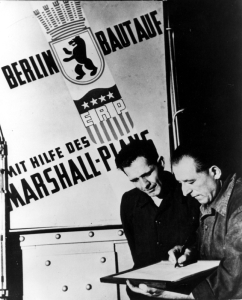
Two workmen looking over a chart with a large sign behind them with German writing.
Marshall Plan in Germany, ca. 1949, Harry S. Truman Library, 338944846.
April 3, 1948
President Truman Signs the Marshall Plan

In 1947, Secretary of State George Marshall proposed that the U.S. provide economic assistance to Europe to help them recover from World War II. President Harry Truman signed the European Recovery Program, or the Marshall Plan, into law on April 3, 1948. By supporting Western Europe's economy, the U.S. aimed to keep the country from falling into another depression through trade with other nations and stop the Soviet Union's control of Eastern Europe from spreading.

Learn More

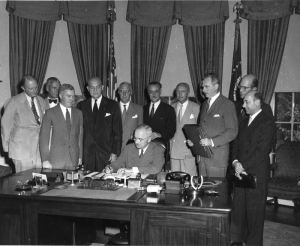
President Truman signing the North Atlantic Treaty Proclamation.
Truman Signs North Atlantic Treaty Proclamation, 24 August 1949, Harry S. Truman Library, 338957532.
April 4, 1949
The North Atlantic Treaty Organization (NATO) Forms

Representatives from 12 countries, including the United States, gathered in Washington, D.C. to sign the North Atlantic Treaty on April 4, 1949, which created the North Atlantic Treaty Organization (NATO). NATO was created partly in response to the Cold War and the spread of communism. The countries vowed to come to the defense of one another, if necessary, and promote peace.

Learn More

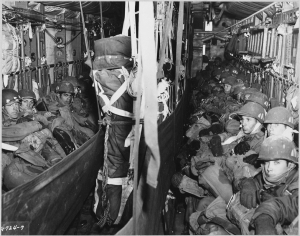
Paratroopers of the 187th Airborne Regimental Combat Team seated in the cargo compartment of a military transport aircraft.
Combat Cargo, Korea -- Paratroopers of the 187th Airborne Regimental Combat Team, Seated in the Cargo Compartment of 314th Troop Carrier Group C-119 "Flying Boxcar," "Sweat Out" the Flight to the Dropzone at Munsan-ni, Korea, in March, 1951, March 1951, National Archives at College Park, 542315.
June 27, 1950
President Truman Commits U.S. Forces to the Korean War

At the end of World War II, Japan was forced to end their 30-year occupation of Korea, which was then divided along the 38th parallel into North and South Korea. With the support of the Soviet Union, North Korea invaded South Korea on June 25, 1950. The United Nations quickly responded, and the United States led the UN's efforts to support South Korea. President Truman described the decision to support South Korea as part of the country's commitment to stopping the spread of communism.

Learn More

A large crowd of Warsaw Pact officers gathered on the upper decks of a Soviet Udaloy-class anti-submarine missile destroyer.
A View of the Warsaw Pact Officers Aboard a Soviet Udaloy Class Cruiser Underway, 26 October 1983, National Archives at College Park, 6380646.
May 14, 1955
Warsaw Pact Forms

The Treaty of Friendship, Cooperation, and Mutual Assistance, more commonly known as the Warsaw Pact, was a mutual defense treaty between Albania, Bulgaria, Czechoslovakia, East Germany, Hungary, Poland and Romania. Created on May 14, 1955, the members of the Warsaw Pact agreed to come to each other's defense if they were attacked by an outside force. Albania withdrew from the pact in 1968, and it officially ended in 1991.

Learn More

  • Manfred Grote and Carl Rollyson, "Warsaw Pact," EBSCO Research Starters, last modified 2023.

Four planes flying above an aircraft carrier during the Bay of Pigs Invasion.
Robert L. Lawson, A4D-2 Skyhawks of VA-34 in Flight Over USS Essex (CVS-9) During the Bay of Pigs Invasion in April 1961, April 1961, Wikimedia Commons, Public Domain, [N/A].
April 17, 1961
Bay of Pigs Invasion

Soon after Fidel Castro took control of Cuba, the U.S. began planning to overthrow him. In 1960, under President Eisenhower, the Central Intelligence Agency started training Cuban exiles for an invasion, and President Kennedy launched the attack. The main invasion force landed at the Bay of Pigs on April 17, 1961, but they were quickly defeated by Castro's forces.

Learn More

  • "The Bay of Pigs," The John F. Kennedy Presidential Library and Museum, last modified November 7, 2024.

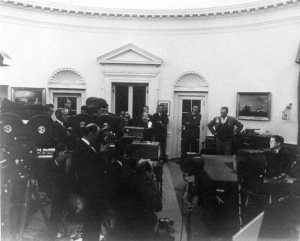
President John F. Kennedy in the Oval Office announcing the U.S. naval blockade of Cuba in front of a gathering of cameras and reporters.
President John F. Kennedy Delivering His Ultimatum to the Russians and Announcing the U.S. Naval Blockade of Cuba, 22 October 1962, Florida Memory, Reference Collection, RC13826.
1962
The Cuban Missile Crisis

On October 16, 1962, President John F. Kennedy and his advisors learned the Soviet Union was installing nuclear missiles in Cuba, just 90 miles away from Florida. The next thirteen days became known as the Cuban Missile Crisis, and the peaceful resolution of the crisis would later be considered one of President Kennedy's greatest achievements.

Learn More

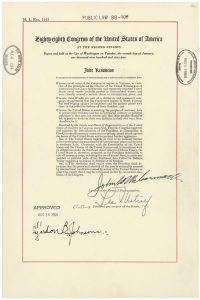
Page of typed text containing the Tonkin Gulf Resolution signed by President Lyndon B. Johnson.
Joint Resolution for the Maintenance of Peace and Security in Southeast Asia, 10 August 1964, Lyndon Baines Johnson Library, 2803448.
August 7, 1964
88th United States Congress Passes the Tonkin Gulf Resolution

On August 4, 1964, President Lyndon B. Johnson announced North Vietnam had attacked two U.S. Navy ships in international waters. President Johnson ordered air strikes in response and asked Congress to pass a resolution to support these actions. Congress passed the Tonkin Gulf Resolution on August 7, 1964, granting President Johnson the power to take military action in Vietnam without a formal declaration of war being passed by Congress.

Learn More

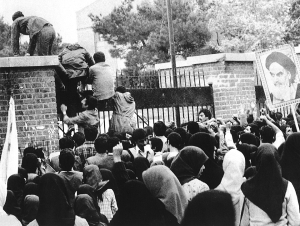
Students climbing over the gate outside the U.S. Embassy in Tehran.
Iran Hostage Crisis - Iranian Students Climb Up U.S. Embassy Gates in Tehran, 4 November 1979, Wikimedia Commons, Shiraz University, Public Domain, [N/A].
November 4, 1979
Iran Hostage Crisis Begins

The Iran Hostage Crisis began on November 4, 1979, when a group of protestors who supported the Iranian Revolution stormed the U.S. Embassy in Tehran and took 66 American hostages. Some of the hostages were released, but 52 people were held for 444 days. The U.S. government's failure to solve the crisis quickly and a failed military rescue damaged the country's reputation as a superpower.

Learn More

A crowd of West German citizens gathered at the newly created opening in the graffiti-covered Berlin Wall at Potsdamer Platz.
A Crowd of West German Citizens Gathers at the Newly Created Opening in the Berlin Wall at Potsdamer Platz, 14 November 1989, National Archives at College Park, 6460115.
November 9, 1989
Fall of the Berlin Wall

On November 9, 1989, a misunderstanding about the changes to travel restrictions between East and West Germany led to thousands of East Germans rushing to the Berlin Wall. The crowd overwhelmed the border guards, and people around the world celebrated the widespread rejection of communism in East Germany.

Learn More