Florida Memory is administered by the Florida Department of State, Division of Library and Information Services, Bureau of Archives and Records Management. The digitized records on Florida Memory come from the collections of the State Archives of Florida and the special collections of the State Library of Florida.

State Archives of Florida
- ArchivesFlorida.com
- State Archives Online Catalog
- ArchivesFlorida.com
- ArchivesFlorida.com
State Library of Florida
Related Sites
 Listen: The Blues Program
Description of previous item
Description of next item
J. C. Penney Had a Farm
Published February 2, 2015 by Florida Memory
If you ever find yourself in Northeast Florida looking for a pleasant route for driving, we recommend State Road 16 between Green Cove Springs and Starke. There's not much traffic, the scenery is nice, and you'll pass through a remarkable relic of Florida history called Penney Farms. At first glance, the town bears the usual hallmarks of a North Florida village – large shade trees, wood-frame houses, and a historical marker here and there. Read one of those markers, however, and you'll learn that Penney Farms was a planned community, developed from scratch in the 1920s by the department store tycoon J. C. Penney himself.

Aerial view of Penney Farms in Clay County, 1940
James Cash Penney came to prominence as a pioneer in the chain store movement in the early years of the 20th century. He opened the first J. C. Penney Store in Kemmerer, Wyoming, and by 1912 had over 30 stores, mainly operating in the West. By 1924, Penney was making over a million dollars annually, which enabled him to pursue a number of philanthropic causes.
In 1922, J. C. Penney purchased 120,000 acres of farmland in Clay County near Green Cove Springs, just east of the St. Johns River. He intended to develop a model farming community, structured similarly to the J. C. Penney department store chain. Just as the chain's directors held stock in the company, farmers would earn interest in Penney Farms by raising crops and purchasing additional interest in the land with the proceeds of their labor.
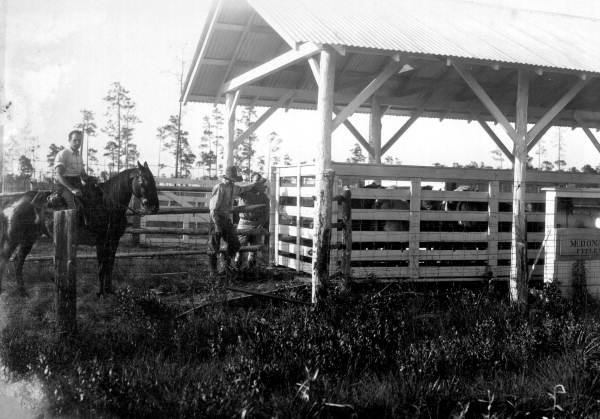
Cattle scales used at Penney Farms, 1931
So who did the farming at Penney Farms? Not just anyone. Persons interested in claiming a tract of land at the new community had to fill out an application. Many of the questions pertained to the applicant's moral character and religious affiliations. A promotional brochure provided a list of characteristics wanted by the company. Penney Farms wanted young to middle-aged men, preferably married, “willing to take advice from others,” and affiliated with some church. The use of “intoxicants or cigarettes” was strictly prohibited. The application asked the prospective farmer to send in a photo of himself or his family if possible, as well as the names and addresses of three persons who could testify to his character.

Application to occupy a farm at Penney Farms – from a promotion brochure dated 1927. Click to enlarge.
By 1927, Penney Farms boasted 20,000 cleared acres, 300 buildings, a general store, a post office, a garage and machine shop, a canning factory, a boarding house, a dairy farm, and 3,000 range cattle. Demonstration plots provided pecans, Satsuma oranges, persimmons, pears, grapes, peppermint, and vegetables. The J. C. Penney-Gwinn Institute of Applied Agriculture had its headquarters on the property, where it provided practical and theoretical training in agriculture and homemaking for the families living at Penney Farms.
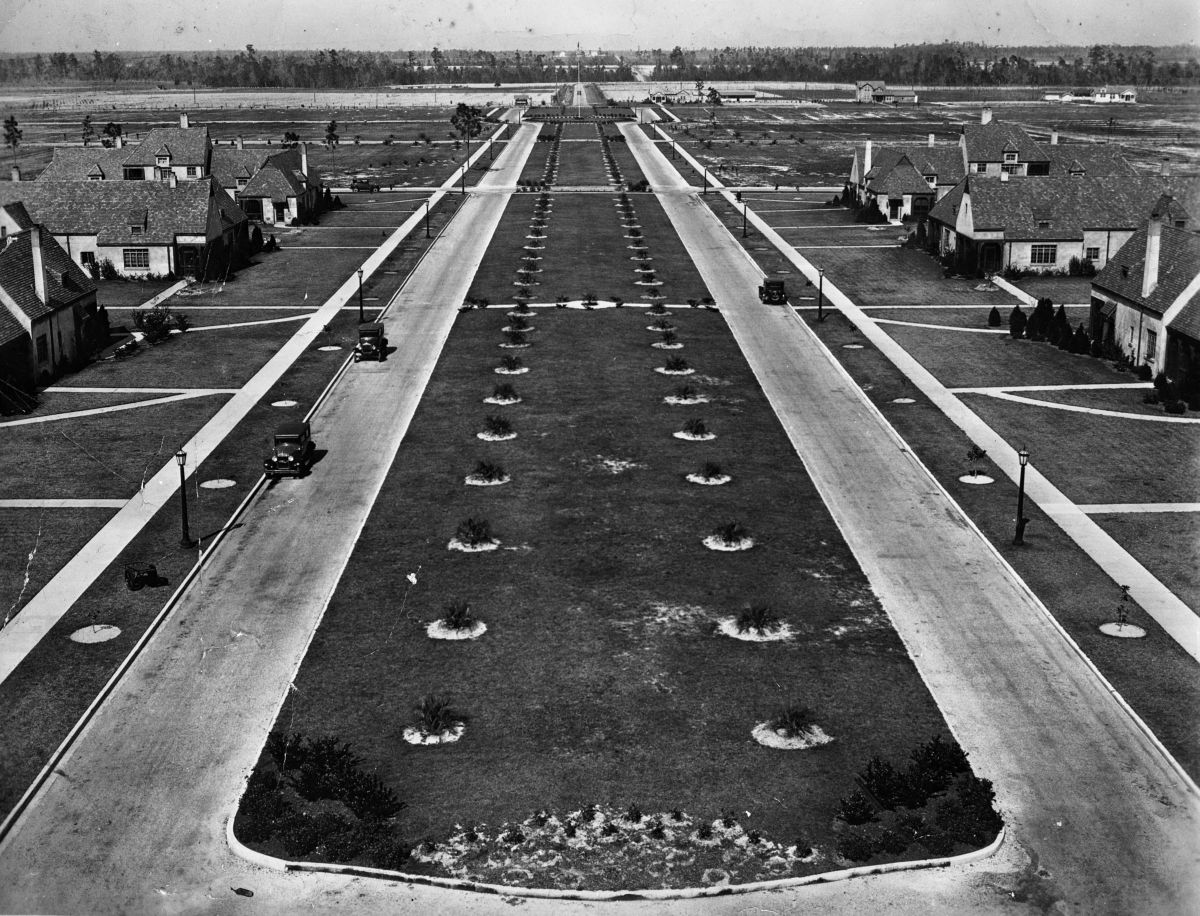
View of a main street in Penney Farms' residential section, ca. 1920s
But there was more to Penney Farms than just farming. J. C. Penney chose to also make this the site for another of his philanthropic endeavors, the J. C. Penney Foundation Memorial Community. This retirement community was built especially for retired ministers and other Christian workers and their wives. The community included 22 furnished apartment buildings, along with the Penney Memorial Chapel. The community was dedicated to the memory of J. C. Penney's parents.

View of the J. C. Penney Foundation's memorial community for retired ministers, Christian workers and their wives, 1958
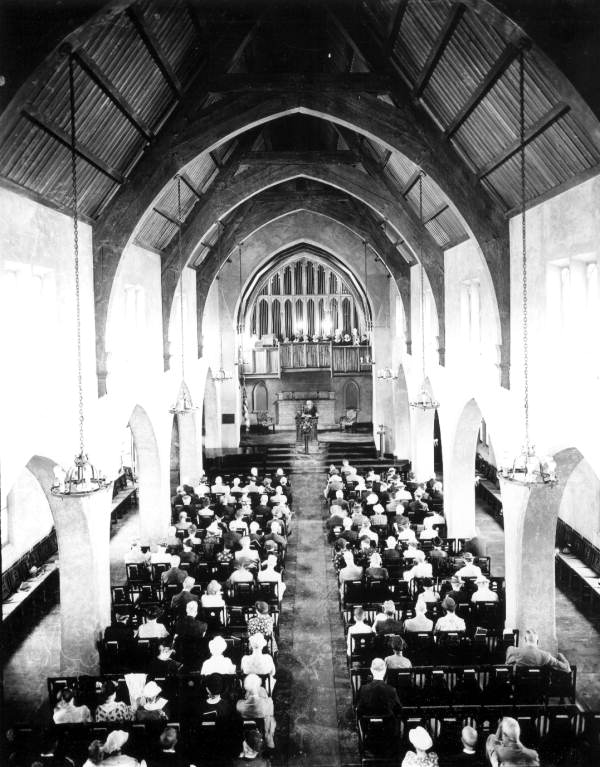
Penney Memorial Chapel at Penney Farms, 1936
The arrival of the Great Depression slowed the development of Penney Farms considerably. Penney himself lost almost all of his personal wealth, and was forced to borrow against his life insurance policies to help his company make payroll. He sold off most of the property comprising Penney Farms, leaving only about 200 acres. He deeded this land to his foundation's Memorial Community, which he gave to the Christian Herald Foundation to run. In 1971, it became the self-sustaining Penney Retirement Community, Inc., and in 1999 it was added to the National Register of Historic Places. Many of the farmers who had relocated to the area to participate in Penney's planned community either bought land or continued working in some capacity in the area. The town of Penney Farms is still incorporated, and as of the 2010 Census it had a population of 749.
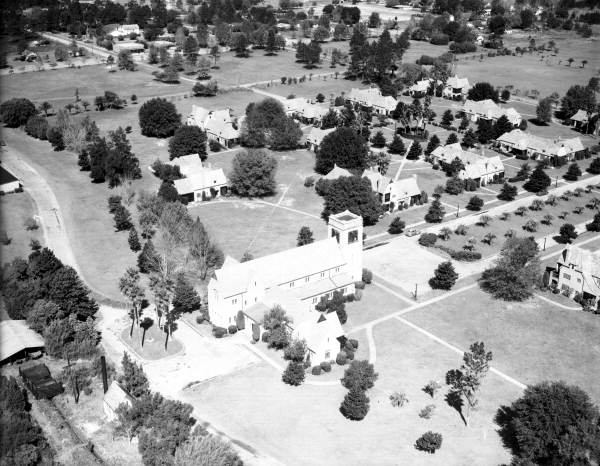
Aerial view of the Penney Memorial Chapel and surrounding buildings, ca. 1947
Cite This Article
Chicago Manual of Style
(17th Edition)Florida Memory. "J. C. Penney Had a Farm." Floridiana, 2015. https://www.floridamemory.com/items/show/274303.
MLA
(9th Edition)Florida Memory. "J. C. Penney Had a Farm." Floridiana, 2015, https://www.floridamemory.com/items/show/274303. Accessed August 15, 2026.
APA
(7th Edition)Florida Memory. (2015, February 2). J. C. Penney Had a Farm. Floridiana. Retrieved from https://www.floridamemory.com/items/show/274303