Florida Memory is administered by the Florida Department of State, Division of Library and Information Services, Bureau of Archives and Records Management. The digitized records on Florida Memory come from the collections of the State Archives of Florida and the special collections of the State Library of Florida.

State Archives of Florida
- ArchivesFlorida.com
- State Archives Online Catalog
- ArchivesFlorida.com
- ArchivesFlorida.com
State Library of Florida
Related Sites
 Listen: The Blues Program
Description of previous item
Description of next item
Raising Cane
Published January 1, 2015 by Florida Memory
Sugar is almost as ubiquitous in Florida history as it is in the American diet. For centuries, settlers have taken advantage of Florida's favorable climate to grow sugar cane for home use or commercial profit.
Sugar cane has been cultivated in Asia since ancient times, but its use in the West was limited until about the 18th century. Honey was the sweetener of choice in Europe before that time. When Europeans began colonizing the Americas during the Age of Discovery, sugar cane was one of the plants they brought to cultivate.

Sugar cane workers collecting sugar cane in a field located near Clewiston, ca. 1980s
Florida's first major sugar cane operations arrived while the British had possession of the territory in the 1700s. Florida's new owners were optimistic about the possibilities for building great profitable plantations along the St. Johns River, and colonial authorities handed out large grants of land to British subjects willing to try their hand at planting.
Denys Rolle and Dr. Andrew Turnbull were among the British planters who attempted to grow sugar cane on their Florida estates. Remains of Turnbull's operation at New Smyrna are still visible today.

Remains of a warehouse at Andrew Turnbull's plantation at New Smyrna Beach, 1953
The United States took possession of Florida in 1821. As planters from Virginia and the Carolinas began moving into North Florida, they were anxious to cultivate new and profitable crops that would solidify their fortunes and those of the new territory. Settlers such as future Florida Governor Thomas Brown, William Wirt, William Nuttall, John and Robert Gamble, and William Bailey invested large sums of money in the equipment necessary to grow cane plants and extract the sugar.

Cane-grinding machine powered by a mule, ca. 1890s. The mule walked around in a circle, activating a pair of rollers. The cane stalks would be fed into the rollers, where it would be crushed and purged out the other side. The juice contained in the stalks was collected and diverted into a vat or barrel.
Their enthusiasm notwithstanding, these early cane growers faced a major problem. The longer sugar cane stays in the ground, the better the sugar it produces. The plant is, however, highly susceptible to freezing. When sugar cane freezes, its ability to produce crystallized sugar is diminished. North Florida cane growers consequently faced something of a guessing game when deciding the right time to harvest their sugar crops. Over time, the risks associated with growing cane became too great for most planters to invest much money in the venture. Many plantations continued to produce smaller amounts of sugar cane for home and local use, but large-scale cultivation of sugar cane was for the most part abandoned by 1840.
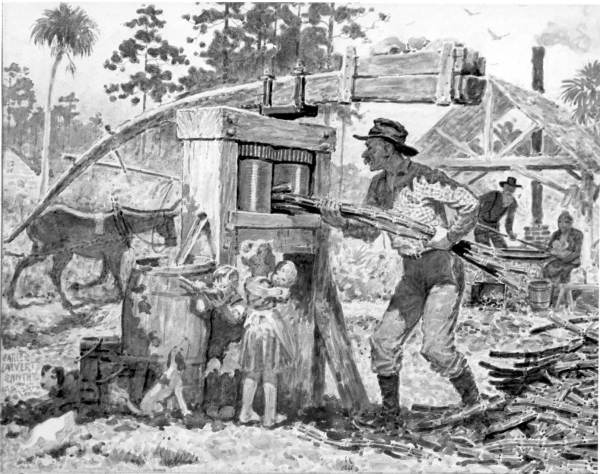
Watercolor by James Calvert Smith of cane grinding process, ca. 1900
Although sugar cane failed as a major cash crop in the 19th century, its presence in Florida pioneer culture at that time was constant and critical. Even if a freeze were to stunt the growth of a cane crop, the plants could still be processed to extract the cane juice, which could then be made into molasses, rum, or cane syrup. These products became staples in the average Florida household.
The act of cutting the cane and extracting the juice was in itself a vital part of local culture, especially in sparsely populated areas. These tasks required a great deal of labor, best accomplished by a community effort. Consequently, many families would hold “cane grindings,” which combined the work of cane processing with the excitement of a communal celebration. The cane would be stripped and fed into a simple machine that crushed it, squeezing out the juice, which was channeled into a waiting vat or barrel. The juice would then be boiled into the various sugar products. There was usually a large meal involved, and sometimes singing and dancing. In a time when homesteads were typically miles apart, this was one of the best ways to get families (expecially the young people) together for a good time. There's no way to know how many Florida marriages began with a simple “How do you do” at an old-fashioned cane grinding.

Group gathered for a cane grinding at the home of William J. Owens of Columbia County, ca. 1890s
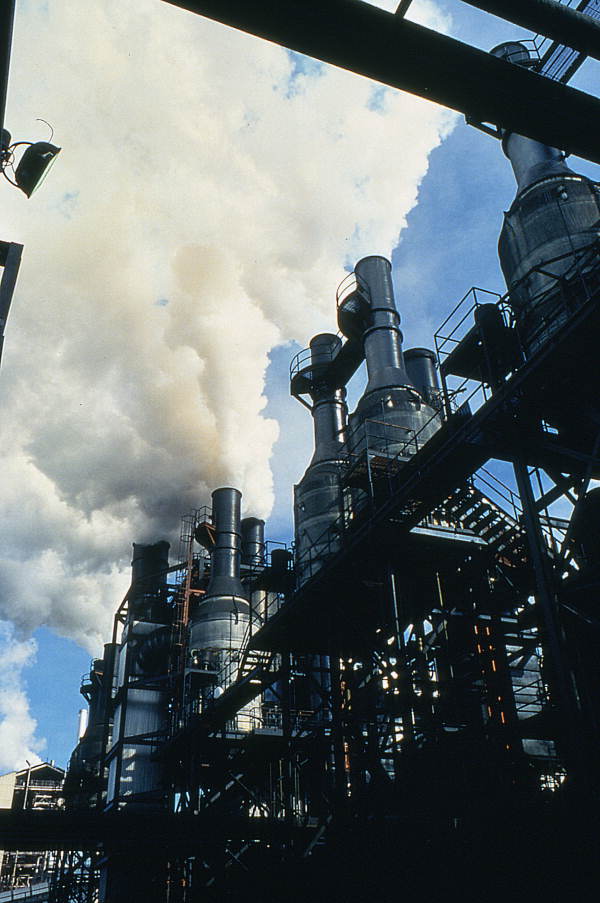
Sugar cane processing plant near Clewiston, ca. 1980s
Sugar cane began to come back into the picture as a commercial enterprise around the turn of the twentieth century. As settlers ventured farther south along the Florida peninsula, they finally encountered areas that either rarely or never suffered from frost. These conditions would best serve large-scale sugar cane production. Developers prepared the terrain for cultivation by diverting rivers and draining large tracts of land, including parts of the Everglades. By the 1920s, the sugar industry was up and running in earnest. The industry received a boost in the 1960s when the federal government banned the importation of Cuban sugar, which had previously been a significant source of the product for the U.S. Today, sugar cane is a multi-billion dollar industry in Florida, producing about 2 million tons of raw sugar annually.
Cite This Article
Chicago Manual of Style
(17th Edition)Florida Memory. "Raising Cane." Floridiana, 2015. https://www.floridamemory.com/items/show/274131.
MLA
(9th Edition)Florida Memory. "Raising Cane." Floridiana, 2015, https://www.floridamemory.com/items/show/274131. Accessed August 15, 2026.
APA
(7th Edition)Florida Memory. (2015, January 1). Raising Cane. Floridiana. Retrieved from https://www.floridamemory.com/items/show/274131