Florida Memory is administered by the Florida Department of State, Division of Library and Information Services, Bureau of Archives and Records Management. The digitized records on Florida Memory come from the collections of the State Archives of Florida and the special collections of the State Library of Florida.

State Archives of Florida
- ArchivesFlorida.com
- State Archives Online Catalog
- ArchivesFlorida.com
- ArchivesFlorida.com
State Library of Florida
Related Sites
 Listen: The Bluegrass & Old-Time Program
Photo Exhibits
Photo exhibits spotlight various topics in Florida history, and are accompanied by brief text intended to place selected materials in historical context.
Spanish Architecture in Florida
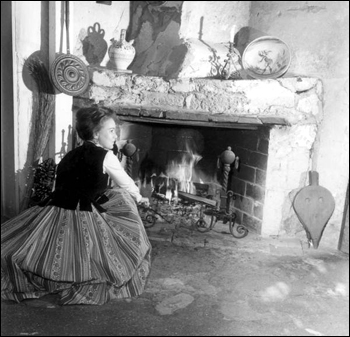
Woman beside the fireplace at the oldest house: Saint Augustine, Florida (1964)
Image Number: C640050b
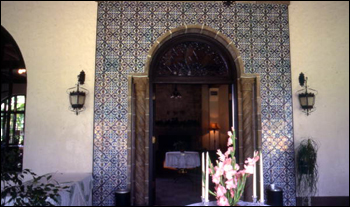
Interior view of the Wakulla Springs Lodge at the Edward Ball Wakulla Springs State Park (1986)
Image Number: COM03962
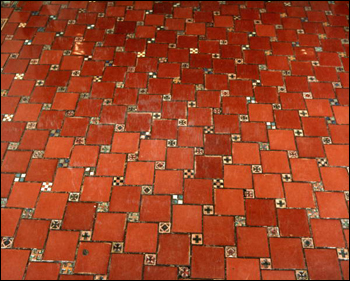
Lobby tiles in building 1 Bay Pines VA Hospital (1983)
Image Number: PR00691
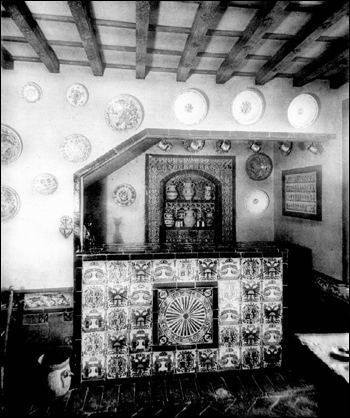
Spanish bar inside Playa Riente: Palm Beach, Florida (ca. 1928)
Image Number: N036636
Architect was Addison Mizner. Built by Joshua Cosden in 1923 and later sold to Mrs. Horace Dodge (later Mrs. Hugh Dillman). It was razed in 1957.
Mizner created what came to be called the Palm Beach style. He combined Spanish, Venetian, and Moorish influences he had collected, largely from his own travels, with a deep understanding of his wealthy patrons' somewhat contradictory interests in extravagance and the facade of authenticity. The style came to dominate the exclusive homes and resorts of Palm Beach and the surrounding area within only a few years of Mizner's arrival in 1918. His sought-after residential designs, such as El Mirasol which he designed for leading Palm Beach socialite Eva Stotesbury, incorporated tradition Spanish hacienda u-shapes that maximized cross-ventilation, substituted subtle mixtures of interior and exterior elevations for the flat Florida landscape, and brought Florida society indoors through balconies, cloister ways, and "loggia," open, Mediterranean-like salon spaces (Hatton, 77-81).
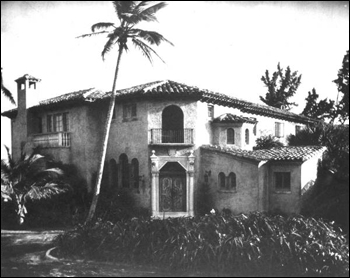
La Bellucia: Palm Beach, Florida (1928)
Image Number: N036646
The house was designed by architect Addison Mizner and built in 1920.
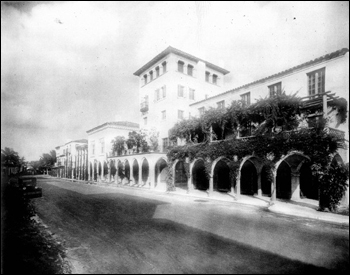
La Bellucia: Palm Beach, Florida (1928)
Image Number: N036658
Designed by architect Addison Mizner and constructed in 1924.
Mizner built clubs, larger homes, and commercial buildings, such such as the eponymous Via Mizner. Those constructions attempted to recreate the ambience of the older, elite homes of Europe, especially imperial Spain, by suggesting former palaces or forts, built piecemeal with the passing fortunes of their owners and rulers, adapted gradually to latter-day peacetime uses (Hatton, 82-83). After bringing his brother on board, Mizner designed and began constructing an entire luxury city dedicated to his ideas. However, after the crash of the Florida land boom and the publicizing of the Mizner brothers' questionable management tactics, investors abandoned the project. The "unleashed" creativity, as Frank Lloyd Wright described it, and romance Addison Mizner employed in recreating Spanish regality left a lasting impression on the cultural and architectural landscapes of the state.
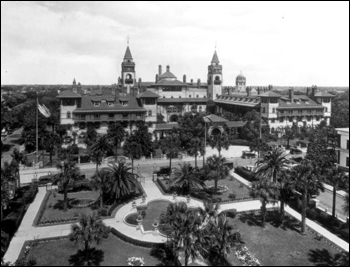
Ponce de Leon hotel as seen from the Alcazar: Saint Augustine, Florida (ca. 1910)
Image Number: RC04768
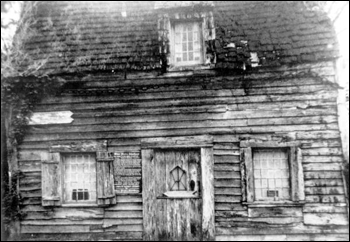
The Paulina Pedroso home at the corner of 8th Avenue and 13th Street, Ybor City: Tampa, Florida (1800s)
Image Number: RC10808
Paulina Pedroso was born and died in Cuba. From the 1880s to 1910, she and her husband, Ruperto, worked at cigar making while organizing La Sociedad Libres on behalf of Cuban freedom. Jose Marti headquartered his activities in the United States in her home.
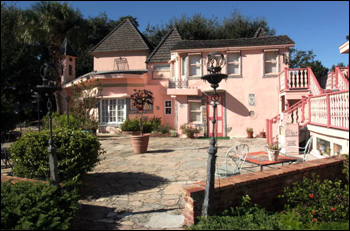
View of the historic Chalet Suzanne in Lake Wales, Florida (2009)
Image Number: PR76133
The Chalet was added to the National Register of Historic Places in 1990.
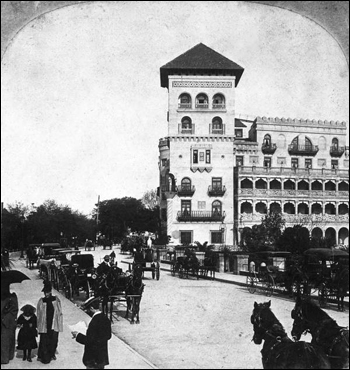
Cordova Hotel on King Street: St. Augustine, Florida (1880s)
Image Number: N039492
Sleeve notes: "In connection with the hotel is a sun parlor 108' long—paved with tiles and roofed with glass. The building is constructed of coquina in the Spanish and Moorish styles of architecture."
Florida experienced several waves of building booms, and many of the new homes, resorts, and town centers constructed as the state's population mushroomed sought to maintain the exotic allure of Florida's unique history. The Spanish Eclectic style of architecture, which featured low-pitched, red-tiled roofs, arches over doors and prominent windows, and white stucco walls, was commonly used for new homes in those parts of the United States that had experienced Spanish Colonial building into the early 20th century. Spanish Eclectic reached its height of popularity in the 1920s and 1930s, with many examples surviving in residential areas across Florida. (Virginia and Lee McAlester, 417-419.)
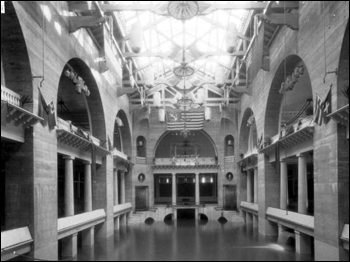
Alcazar hotel casino pool: Saint Augustine, Florida
Image Number: RC19678a
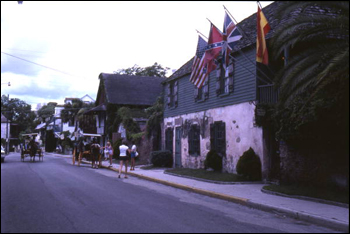
Street scene in front of the Oldest House: Saint Augustine, Florida (1982)
Image Number: PR14378
In addition to private homes and prominent commercial buildings, many of Florida's historic sites, civic buildings, and notable destinations incorporate the state's strong connection to Spanish Colonial heritage into the public space Florida's millions of residents and annual visitors share.
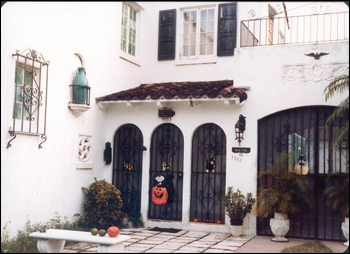
Home of Roxcy Bolton at 1302 Alhambra Circle decorated for Halloween: Coral Gables, Florida (1970s)
Image Number: PR20647
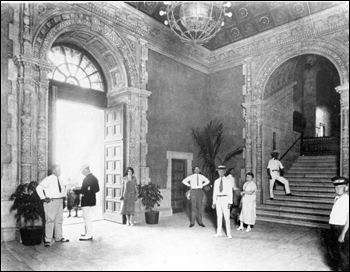
Inner hotel architecture (1930)
Image Number: PR06851
James M Cox Sr., former governor of Ohio and owner of the Miami Daily News and Metropolis, spent $1.5 million to build the lavish News Tower, later renamed Freedom Tower.
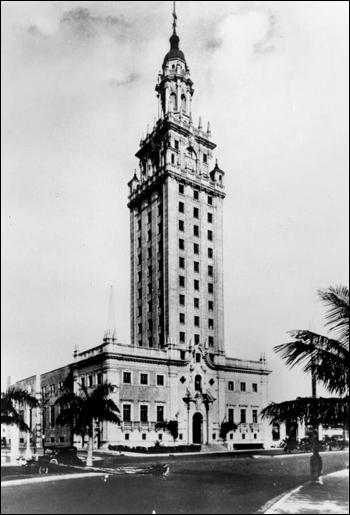
News Tower (1930s)
Image Number: PR06853
The News Tower, later renamed Freedom Tower, was patterned after the 800-year-old Giralda bell tower in Seville, Spain.
Features
Territorial Legislative Council Records, 1822-1845
Documenting Florida's legislature prior to statehood
State and County Officer Directories, 1868-1969
Lists of Florida's state and county officials either elected or appointed between 1868 and 1969.

Guide to Military Records and the Wartime Experience
A guide to government records and manuscript collections relating to service members and the wartime experience.
Dust Tracks
21 tracks from Hurston's time documenting African American culture for the WPA in 1930s Florida.
History Day 2025
Resources for Florida History Day from the State Library and Archives of Florida.